
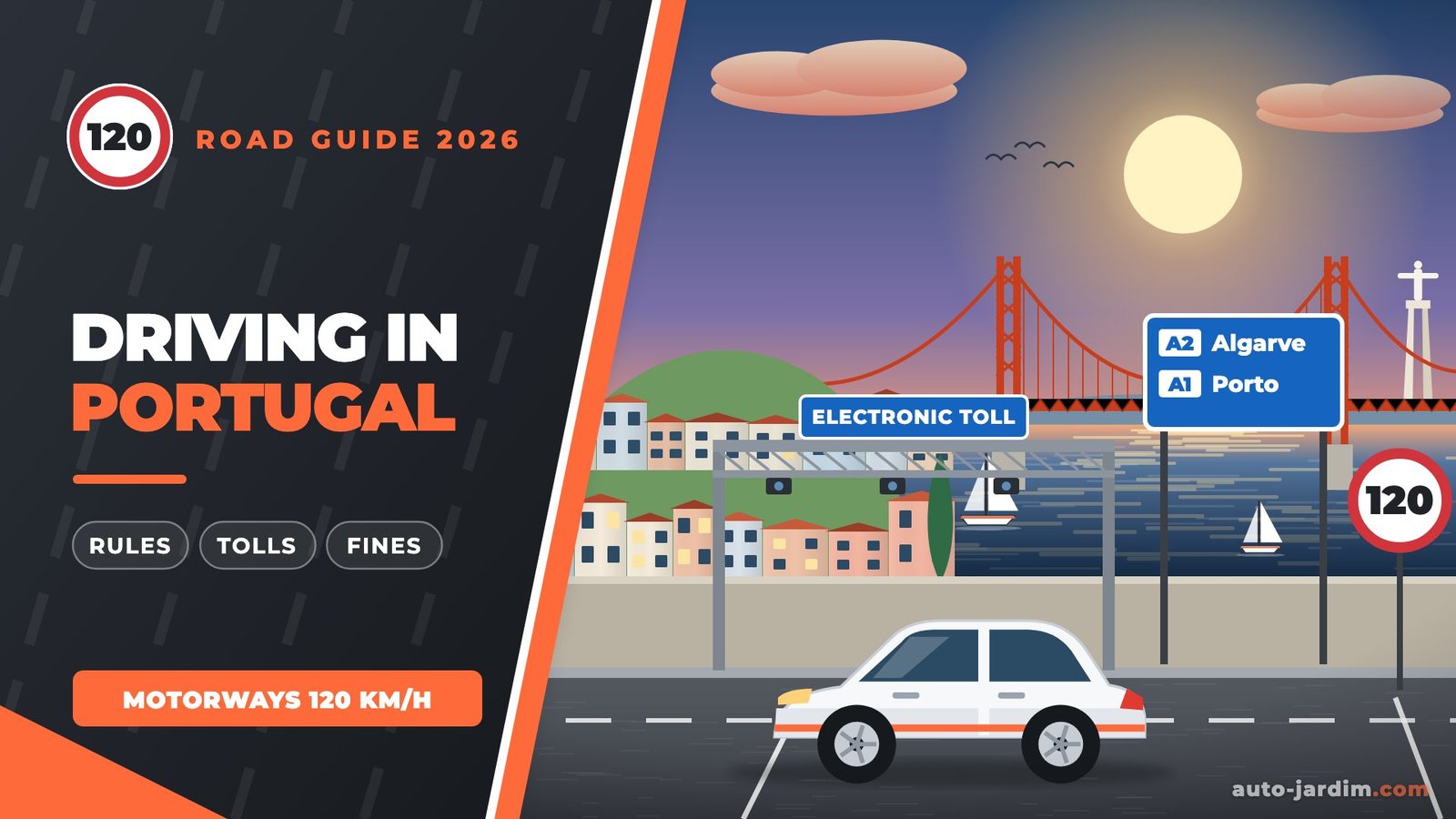
In Portugal you drive on the right. The speed limit for cars is 50 km/h in towns, 90 km/h on other roads, 100 km/h on expressways and 120 km/h on motorways, and the alcohol limit is 0.5 g/l. Most motorways charge tolls and many have no booths at all, so cars rented in Portugal come with an electronic toll device: the five companies we checked charge €1.80 to €2.36 a day for it, each with its own cap. Fuel averaged €2.05 a litre for petrol and €2.27 for diesel on 6 November 2026. Licences from the EU, the UK, the US, Canada and Brazil are valid for up to 185 days. Below are the fines, the toll rules for rental cars and calculators for your own trip.
| Rule | Portugal, 2026 |
|---|---|
| Side of the road | Right. Overtake on the left |
| Towns and villages | 50 km/h (20 km/h in shared “coexistence” streets) |
| Other roads | 90 km/h |
| Expressways for cars only | 100 km/h |
| Motorways | 120 km/h, minimum 50 km/h |
| Alcohol | 0.5 g/l; 0.2 g/l for probationary and professional drivers |
| Phone | Hands-free or a single earpiece only; €250 to €1,250 |
| Children | Under 12 and under 135 cm: approved child seat, in the back |
| Must be in the car | Warning triangle and reflective vest |
| Tolls | Booths on some motorways, cameras only on others; rental cars use a device |
| Fuel, 6 Nov 2026 | Petrol 95 €2.049, diesel €2.271 per litre (national average) |
| Emergency | 112 |
Sources: Código da Estrada (consolidated, Diário da República), DGEG fuel prices, US State Department (112). Checked on 8 November 2026.
The limits come from article 27 of the Código da Estrada, the Portuguese Highway Code. They apply unless a sign says otherwise, and local signs can set lower or higher limits on a stretch of road. The last change to the Code was in April 2025 and only concerned motorcycle parking, so the limits and fines below did not change in 2025 or 2026. Higher fines have been announced in the Portuguese press in 2026, but nothing had been published in the official gazette by 8 November 2026.
| Road | Car | Car with trailer |
|---|---|---|
| Coexistence zone (shared street) | 20 km/h | 20 km/h |
| Inside towns and villages | 50 km/h | 50 km/h |
| Other roads outside towns | 90 km/h | 70 km/h |
| Expressways reserved for cars and motorcycles | 100 km/h | 80 km/h |
| Motorways (autoestradas), minimum 50 km/h | 120 km/h | 100 km/h |
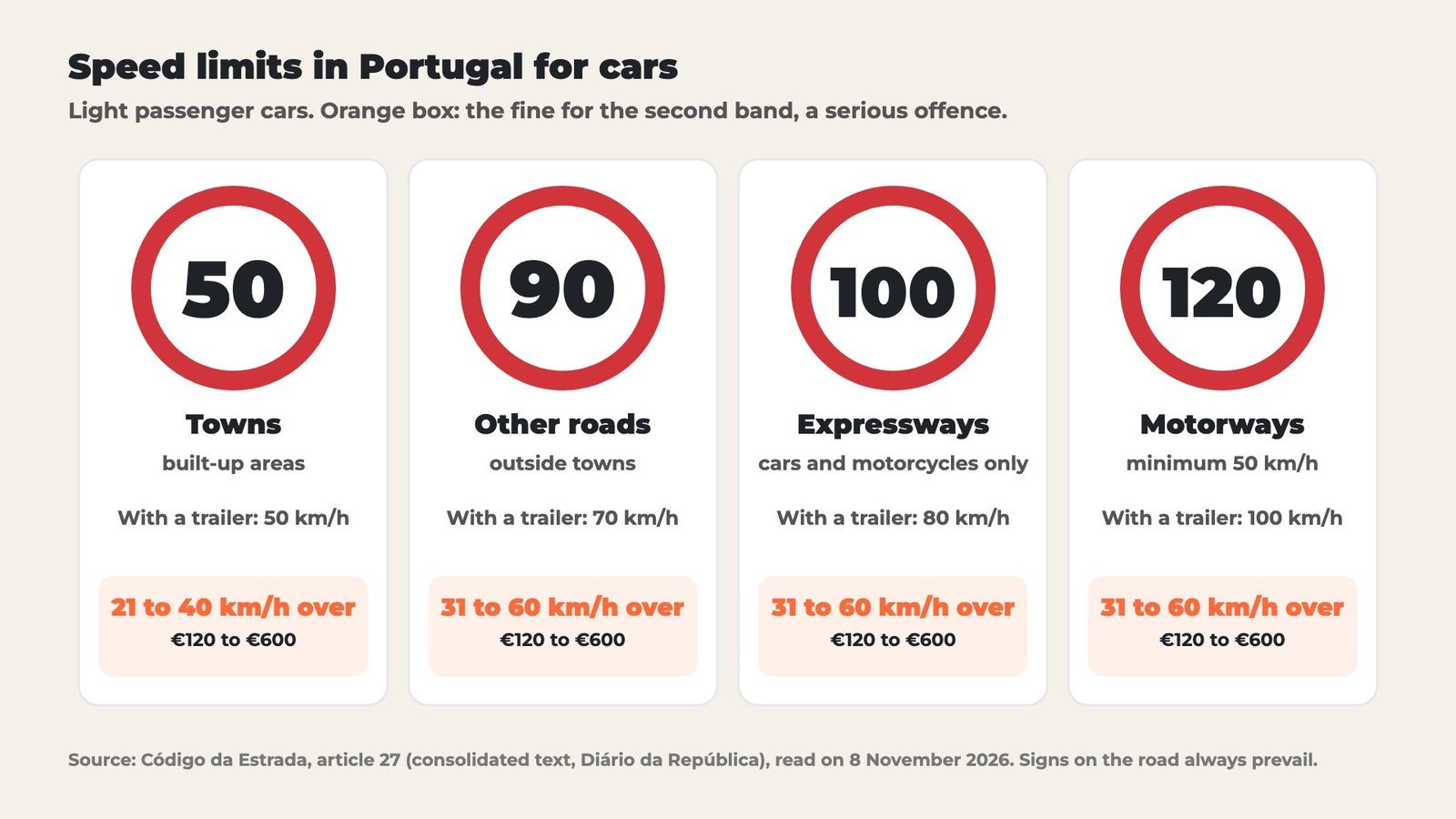
Having held your licence for less than a year does not lower your speed limit in Portugal, whatever older guides say: the current Code has no such rule. What changes for new drivers is the alcohol limit.
Fines depend on how far you were over the limit, and the bands are tighter in towns than outside them. Serious and very serious speeding offences can also lead to a driving ban (inibição de conduzir) on top of the fine.
| Over the limit in towns | Over the limit outside towns | Fine | Classification |
|---|---|---|---|
| up to 20 km/h | up to 30 km/h | €60 to €300 | Minor |
| 21 to 40 km/h | 31 to 60 km/h | €120 to €600 | Serious (grave): a driving ban of 1 month to 1 year may also apply |
| 41 to 60 km/h | 61 to 80 km/h | €300 to €1,500 | Very serious (muito grave): a driving ban of 2 months to 2 years may also apply |
| over 60 km/h | over 80 km/h | €500 to €2,500 | Very serious (muito grave) |
Pick the road and the speed a camera or police officer measured. Fines for cars under article 27 of the Highway Code, checked on 8 November 2026.
The national camera network, SINCRO, has 123 sites according to the road safety authority ANSR. 100 of them measure your speed at one point and 23 measure your average speed between two points, for example on the A1 near Mealhada and Santarém, the IC19 in Sintra and the EN10 at Vila Franca de Xira. Every site is signed in advance, and ANSR publishes the full list on radaresavista.pt. Radar detectors and jammers are illegal: €500 to €2,500, and the device is confiscated.
The general limit is 0.5 g/l of alcohol in the blood. It is 0.2 g/l for drivers in their probationary period, professional drivers, taxi and ride hailing drivers, and for school transport and emergency vehicles. If you passed your test recently, the safest plan is not to drink at all before driving.
| Blood alcohol | What happens |
|---|---|
| Under 0.5 g/l (under 0.2 for probationary drivers) | No offence |
| 0.5 to under 0.8 g/l | €250 to €1,250, serious offence, possible ban |
| 0.8 to under 1.2 g/l | €500 to €2,500, very serious offence, possible ban |
| 1.2 g/l or more | Crime: up to 1 year in prison or a fine, plus a ban of 3 months to 3 years |
You may not hold or keep handling a phone while the car is moving. A hands-free system or a single earpiece is allowed. The fine is €250 to €1,250 and it counts as a serious offence. Everyone in the car must wear a seat belt (€120 to €600).
Children under 12 who are shorter than 135 cm need an approved child seat that fits their size and weight, and they must sit in the back. A child under 3 may sit in front only in a rear facing seat with the passenger airbag switched off, and a child of 3 or older only if the car has no rear seat or no rear seat belts. The fine is €120 to €600 per child. Book child seats together with the car.
Roundabouts are everywhere in Portugal, often with two or three lanes, and article 14-A of the Code says how to use them:
Getting it wrong costs €60 to €300.
Every car must carry a reflective vest and a warning triangle of an approved type. If you stop on the carriageway or hard shoulder, put the triangle at least 30 m behind the car so it is visible from 100 m, and wear the vest while you do it. A missing item costs €60 to €300 each; not using them costs €120 to €600. The Code does not say where the vest must be kept, but inside the car, not in the boot, is where you can reach it safely. In daylight, dipped headlights are compulsory in signed tunnels, on reversible lanes and whenever visibility is poor, for example in fog or heavy rain.
An EU or EEA licence is valid until it expires. Licences from countries that signed the 1949 Geneva or 1968 Vienna road traffic convention, or have an agreement with Portugal, can be used for up to 185 days after you enter the country, as long as you do not take up residence. The transport authority IMT lists the US, Canada and the UK among them, and Brazil as a Portuguese speaking convention country. Licences from countries with neither a convention nor an agreement are not valid.
The minimum age to drive is 18, but rental companies set their own minimums, usually 19 or 21, and charge a young driver fee up to 24.
Based on IMT, the UK, US and Canadian government advice and the rental terms of Goldcar, Centauro, Europcar, Avis and Guerin, read on 8 November 2026.
Portugal has two kinds of toll motorway. On roads like the A1 (Lisbon to Porto) and the A2 (Lisbon to the Algarve) there are toll barriers: you take a ticket and pay at a booth, or drive through an electronic lane with a toll device. On others there are no booths, only gantries with cameras, and you need an electronic way to pay. Since 1 January 2025 Law 37/2024 has removed tolls from several former “SCUT” concessions: the A4 Transmontana and Marão Tunnel, the A13 and A13-1 Pinhal Interior, the A22 in the Algarve, the A23, A24, A25 and two sections of the A28.
A car rented in Portugal makes this easy. All five companies we checked fit a Via Verde device in their Portuguese cars, citing Portuguese law, and charge the tolls to your card after the rental. At toll barriers you use the lanes reserved for electronic payment instead of stopping at the booth. In 2026 a car pays €25.05 from Lisbon to Porto and €23.80 from Lisbon to Faro. The Lisbon bridges charge only when you drive into the city: €2.25 on the 25 de Abril bridge and €3.40 on the Vasco da Gama bridge, according to Lusoponte. Our guide to tolls in Portugal and the Portugal toll calculator cover other routes.
| How to pay | Where it works | Cost on top of the toll |
|---|---|---|
| Rental car toll device (Via Verde) | Every motorway and both Lisbon bridges | €1.80 to €2.36 a day, capped (see the company table) |
| Cash or card at the booth | Motorways with toll barriers, such as the A1 and A2 | Nothing |
| Post payment at CTT, Payshop or Multibanco | Electronic-only motorways; foreign plates should activate a payment method first | €0.32 per passage (max €2.56 per payment), within 15 business days |
| EasyToll (card linked to a foreign plate) | All motorways except the two Lisbon bridges | €1 plus €0.32 per trip, valid 30 days |
| Tollcard (prepaid €5 to €40) | All motorways except the two Lisbon bridges | €1 plus €0.32 per trip, valid 1 year |
Sources: Infraestruturas de Portugal (pttolls.com), Brisa 2026 toll table, Via Verde toll calculator, Law 37/2024. Read on 8 November 2026.
The table shows the terms of five companies that rent cars across Portugal, read in their own 2026 documents. Sixt and Hertz block automated reading of their terms, so they are not in it.
| Company | Minimum age | Toll device fee | Driving into Spain |
|---|---|---|---|
| Goldcar | 21 | €1.80 a day, max €18 (refunded if no electronic tolls) | €12 a day, max €156 |
| Centauro | 19 | €2.21 a day, max €22.14 | €14 to €32 a day, max €168 |
| Europcar | 19 | €2.21 a day, max €22.14 | €13.20 a day |
| Avis | 21 (20 in the Azores) | €2.21 a day, charged for max 10 days | €8 a day, max 5 days |
| Guerin | 21 | €2.36 a day, only days used, max 10 days | Paid “Cross Border” product |
Our guide to cheap car rental in Portugal compares prices by city and airport. Two things are worth knowing before you book. First, most companies charge the toll device fee per rental day, not per toll (Guerin only for days you use it), so on a long rental the cap matters more than the daily price. Second, all five allow trips to Spain only with their paid cross-border option, so arrange it before you cross if you plan a day in Seville or Galicia. Crossing without it costs extra under their terms, for example €15 a day at Goldcar and €16.50 a day at Europcar.
Fuel stations report their pump prices to Portugal’s Directorate-General for Energy and Geology (DGEG). Averaging the prices of about 3,000 stations, last updated on 6 November 2026, gives €2.049 a litre for petrol 95 and €2.271 for diesel, so diesel is the more expensive fuel at the moment.
| Fuel, average price per litre | Portugal | Lisbon district | Porto district | Faro district |
|---|---|---|---|---|
| Petrol 95 (gasolina simples 95) | €2.049 | €2.059 | €2.043 | €2.056 |
| Diesel (gasóleo simples) | €2.271 | €2.285 | €2.268 | €2.281 |
Source: DGEG, precoscombustiveis.dgeg.gov.pt, simple average of 3,034 station prices for petrol 95 and 2,871 for diesel. Read on 8 November 2026.
Not every station takes every card: the fuel authority ENSE says sellers are not obliged to accept cards. Carry some cash for small rural stations. Our fuel cost calculator works out the cost of a single journey.
Many historic centres in Lisbon, Porto, Sintra and the Algarve towns have narrow streets and few parking spaces. It is usually easier to leave the car in a car park at the edge and walk in. Each town sets its own paid parking zones, hours and prices, and some charge at weekends too: see our guide to parking in Portugal for the city rules.
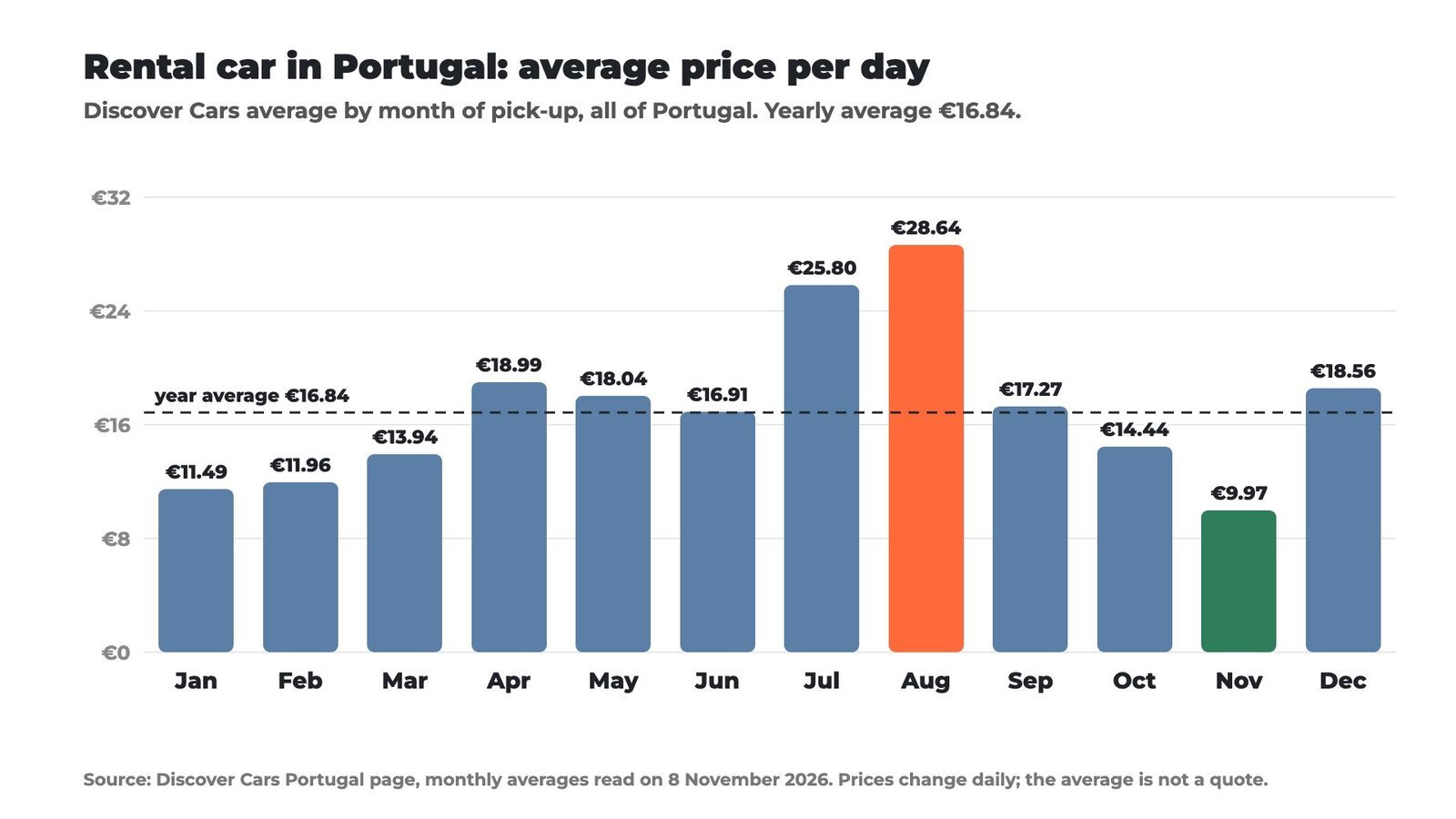
A rental car in Portugal averaged €16.84 a day over the year on Discover Cars, from €9.97 in November to €28.64 in August. Add fuel, tolls and the toll device fee, and you can estimate the cost of a road trip around Portugal.
Rental price = Discover Cars average for the month. Fuel = average of DGEG station prices updated to 6 November 2026, at 6.5 l/100 km for petrol and 5.5 l/100 km for diesel. Tolls = class 1 car, 2026.
If the police notify you of a traffic offence, you must pay a deposit equal to the minimum fine at once or within 48 hours, the US State Department notes that police take cards on a portable machine. If you do not, the police can provisionally keep your licence or the car documents and issue temporary replacement documents. The deposit is refunded if no penalty is imposed in the end. After an accident, switch on the hazard lights, put on the vest before you step onto the road, set up the triangle, call 112 if anyone is hurt or the road is blocked, and then call the assistance number on the rental agreement.
Tick what you have sorted. Nothing is saved or sent.
For cars: 50 km/h in towns, 20 km/h in shared coexistence streets, 90 km/h on other roads, 100 km/h on expressways reserved for cars and motorcycles and 120 km/h on motorways. With a trailer the limits outside towns drop to 70, 80 and 100 km/h. The minimum speed on motorways is 50 km/h.
Not for a short visit with a licence from the EU, the UK (photocard), the US, Canada or Brazil. Portugal’s transport authority IMT accepts these licences for up to 185 days after you arrive, and none of the UK (for photocard licences), US or Canadian government pages makes an IDP compulsory. Rental companies can set their own rules, so check your voucher.
Yes. The United States is on IMT’s list of convention countries, so a valid US licence works for up to 185 days after you enter Portugal, as long as you do not become resident. The US State Department says up to 6 months.
The five rental companies we checked fit a Via Verde toll device in every car, citing Portuguese law. It records every toll, including the camera-only motorways and the Lisbon bridges, and the company charges the tolls to your card after the rental, plus a device fee of €1.80 to €2.36 a day with a cap. Lisbon to Porto costs €25.05 and Lisbon to the Algarve €23.80 for a car in 2026.
0.5 g/l of alcohol in the blood, and 0.2 g/l for drivers in their probationary period, professional drivers, taxis and ride hailing drivers. From 0.5 g/l the fine is €250 to €1,250; from 1.2 g/l driving under the influence is a crime with up to a year in prison.
You must pay a deposit equal to the minimum fine immediately or within 48 hours. If you do not, the police can provisionally keep your driving licence or the car’s documents and issue temporary replacements. The deposit is refunded if no penalty is imposed in the end.
The national SINCRO network has 123 camera sites: 100 measure your speed at one point and 23 measure the average speed over a section. All of them are signed, and the road safety authority ANSR publishes the full list on its website radaresavista.pt. Radar detectors are banned, with a fine of €500 to €2,500.
Carry your driving licence, ID and the car documents. The car must also have an approved reflective vest and warning triangle. Rental cars should have both; the US State Department advises checking for them before you drive off. Missing equipment costs €60 to €300 per item.
Yes, at all five companies we checked, but only with their paid cross-border option: for example €12 a day (max €156) at Goldcar, €13.20 a day at Europcar and €8 a day (max 5 days) at Avis. Driving into Spain without it brings a penalty, such as €15 a day at Goldcar.
Sources: Código da Estrada, consolidated text on Diário da República (articles 14-A, 27, 55, 61, 81, 82, 84, 88, 147, 148, 173) and Penal Code article 292; ANSR, radaresavista.pt (SINCRO list, July 2026); IMT pages on foreign licences; US State Department, UK government and Government of Canada travel advice for Portugal; Infraestruturas de Portugal (pttolls.com); Brisa 2026 toll table; Via Verde toll calculator; Law 37/2024; Lusoponte; DGEG fuel prices; ENSE; rental terms of Goldcar, Centauro, Europcar, Avis and Guerin; Discover Cars Portugal page. All read on 8 November 2026.
Disclosure: some links on this page are affiliate links to Discover Cars. If you book through them we may earn a commission at no extra cost to you. The rental companies named here do not pay us.
Last updated: 8 November 2026