
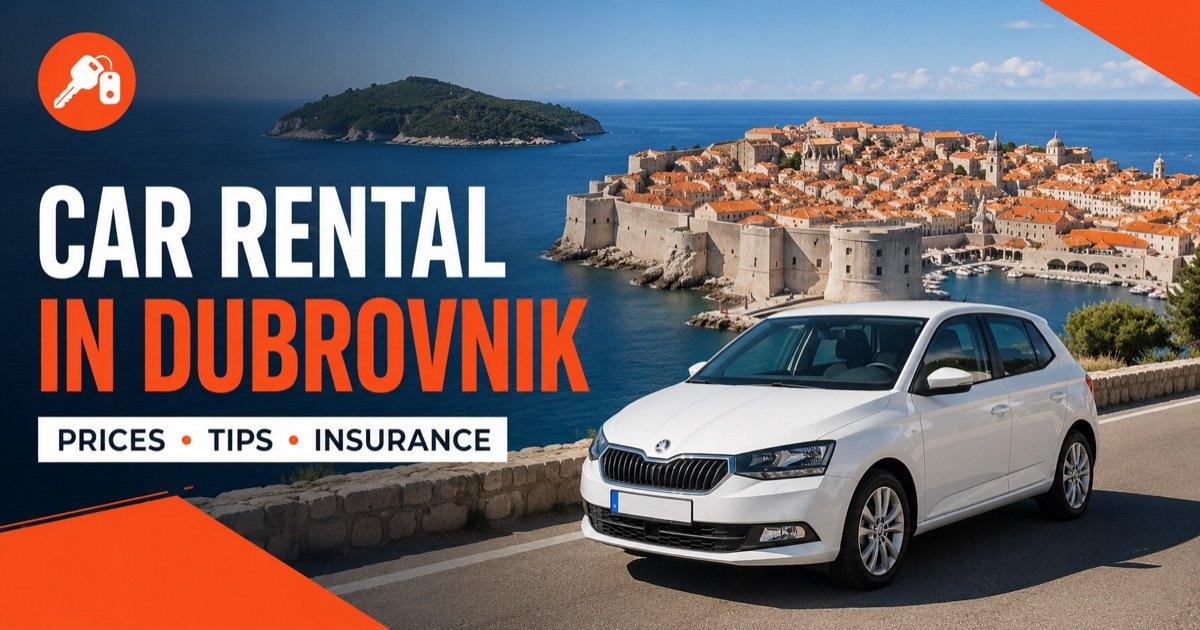
Renting a car in Dubrovnik opens up the whole southern Adriatic – the Pelješac wine peninsula, the Konavle valley and an easy day trip into Montenegro – with economy cars from around €30–45/day ($33–$49) in low season. Croatia uses the euro (since 2023) and drives on the right. You won't need the car for the Old Town itself (it's pedestrian and walled), but it's the key to everything beyond. This is our first-hand guide to car rental in Dubrovnik: the real prices, the tolls, and the best drives.

Dubrovnik from above – the Old Town is car-free, but a hire car unlocks the coast and the islands' gateways.
Most rentals are collected at Dubrovnik Airport (DBV, about 20 minutes south of the city) or in town. Summer is peak and pricey; book early. Expect roughly the following in 2026:
Average Daily Rates in Dubrovnik by Season
Booked 3–5 weeks in advance, prices in EUR
| Season | Manual Economy | Manual Compact | Automatic Compact |
|---|---|---|---|
| Low (Nov–Mar) | €30–45 | €36–52 | €48–68 |
| Shoulder (Apr–Jun, Oct) | €40–58 | €48–68 | €60–85 |
| Peak (Jul–Sep) | €55–85 | €65–100 | €85–130 |
Dubrovnik is one of Croatia's priciest markets in summer – book well ahead.
Estimated rental cost by trip length
from €30/day
Illustrative — daily rate × days at the lowest 2026 starting price; real prices vary by season & demand.
Dubrovnik Rental Budget Calculator
Compare live Dubrovnik car rental prices →Rate prefilled with the lowest low-season economy rate; change it for your dates.
Both international brands (Sixt, Europcar, Hertz, Avis) and strong Croatian operators serve Dubrovnik Airport and the city. The airport is the easiest pickup; the Old Town has no parking, so a car is for exploring beyond, not for the centre.

We based ourselves near the coast and used the car for the Pelješac peninsula, Konavle and Montenegro.
Confirm whether you collect at the airport or in town, the deposit and card requirement. Read the fuel and insurance terms, and – crucially for Dubrovnik – tell the company if you plan to cross into Montenegro or Bosnia, as a cross-border/Green Card permit and extra fee are usually required.
Well-established Croatian companies often beat the chains on price and handle cross-border permits smoothly. Choose ones with strong recent reviews and a clear written rate.
A dependable international major with a broad fleet and good automatic availability at Dubrovnik Airport.
The pick for a newer fleet at DBV. Pricier; decline the counter extras.
Reliable majors with airport presence – compare their all-in price against the Croatian operators.
The very cheapest listings can carry large deposit holds, strict fuel rules, and sometimes refuse cross-border travel. Read the fine print, especially if you want Montenegro.
Croatian rentals come with CDW, but the excess and deposit can be high in Dubrovnik. Standalone excess insurance bought before you travel is cheaper than the counter product. For Montenegro/Bosnia, confirm the cross-border permit and Green Card – this is separate from your excess cover.
Insurance Cost Comparison: 7-Day Dubrovnik Rental
2026 pricing
| Option | Daily Cost | 7-Day Total | Covers Tyres/Glass? |
|---|---|---|---|
| Basic CDW (included) | €0 | €0 | No |
| Counter Super CDW | €14–24 | €98–168 | Sometimes |
| Third-party excess cover | €4–7 | €28–49 | Yes |
Croatia uses distance-based motorway tolls (no vignette) – you take a ticket and pay at the exit by cash or card. The A1 from Zagreb runs south toward Dubrovnik: Zagreb–Split costs about €26 for a car, and continuing to Ploče, where the motorway ends, about €34. The final stretch to Dubrovnik is the coastal D8, which crosses the toll-free Pelješac Bridge – this bypasses the old Bosnia (Neum) corridor, so no passport control.
| Cost item | Croatia (2026) | Notes |
|---|---|---|
| Motorway toll (A1, distance-based) | ~€26 Zagreb–Split, ~€34 to Ploče | Cash or card at the exit; motorway ends at Ploče |
| Pelješac Bridge (D8) | Free | Bypasses the Bosnia/Neum corridor |
| Petrol (95) | ~€1.72/L | Pay cash or card |
| Diesel | ~€1.99/L | Now dearer than petrol |

The quieter beaches and coves south of the city are easiest with your own car.
The single best day trip – the fjord-like bay and walled Kotor. Arrange the cross-border permit first. If you would rather pick the car up on the Montenegrin side, see our Kotor car rental guide.
Croatia's red-wine country, oyster beds and the great wall of Ston, via the new bridge.
Vineyards, watermills and the quiet south toward Cavtat.
A pretty harbour town near the airport, calmer than the city.
Drive to the ferry and visit the forested island's salt lakes.

Into Montenegro – the Bay of Kotor is an easy, spectacular day trip with the right cross-border paperwork.
Not for the Old Town, which is pedestrian and walled. But a car is the best way to reach Montenegro, the Pelješac wine peninsula, Konavle and the quieter beaches – everything beyond the city centre.
Usually yes, but you must tell the rental company in advance. They issue a cross-border letter and the international insurance Green Card, normally for an extra fee. Without it you can be turned back at the border.
No – the Pelješac Bridge (opened 2022) lets you bypass the Bosnia “Neum corridor” entirely on Croatian territory, with no passport control. The bridge itself is toll-free.
Yes – Croatian motorways use a distance-based toll (no vignette), paid by cash or card at the exit. The A1 from Zagreb costs about €26 to Split and about €34 to Ploče, where the motorway ends. The coastal D8 on to Dubrovnik and the Pelješac Bridge are free.
The euro – Croatia adopted it on 1 January 2023, so prices, tolls and fuel are all in euros.
Low-season manual economy cars start at €30–45/day ($33–$49). Shoulder season is €40–58/day and peak summer €55–85/day, with automatics more. Book early – summer is pricey.
Disclosure: This guide is based on our own southern-Adriatic road trip plus operator information and current road data. Auto Jardim participates in the DiscoverCars affiliate program. We only recommend services we would use ourselves.
Last updated: September 2026. Prices, tolls and road works change – always verify directly before travelling.